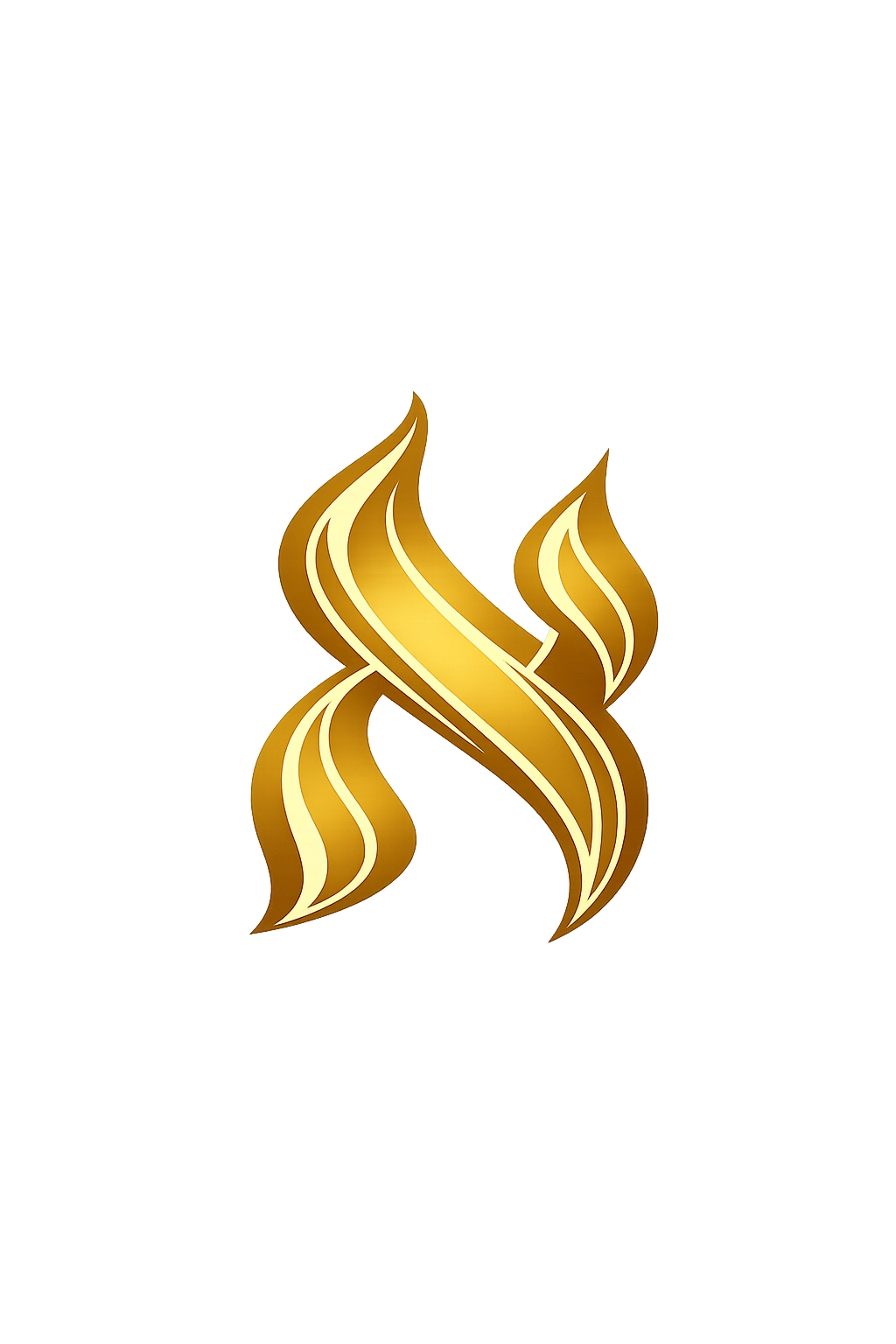
Torat Mashiach: The Vav Reveals the Tree of Life
“For the matter is very close to you, in your mouth and in your heart, to do it.” [Devarim 30:14]
The deepest secrets of Torah are not far away in some abstract heaven. They are not symbols meant to remain symbols. They are instructions for how the divine image is restored inside a human being through speech, heart, and action. The mistake is to think that the inner Torah is somewhere else. The Torah says it is close, and the closer we look, the more we discover that the worlds, the sefirot, the ladders, the trees, the waters, and the letters are also maps of the soul.
This is also where the heart comes in. When Torah is “close,” it is not only that the mind understands. It is that the heart becomes a repaired vessel that can receive and transmit what the mind knows, until “in your mouth” and “to do it” become real. [Devarim 30:14; Bereishit 1:27]
Ramchal teaches in Derech Etz Chayim that Torah is not merely information. Torah is divine light entering the soul. He explains the verse “וְתוֹרָה אוֹר,” “and Torah is light,” as literal spiritual reality: Torah is not like ordinary wisdom that the intellect merely grasps from the outside. When a person works to understand Torah, Torah works to change the person from within. The light does not remain above the mind as an idea. It descends, enters, clarifies, burns away confusion, and slowly forms a new person from within. [Derech Etz Chayim, Ramchal]
Tikkunei Zohar gives us the key through the Aleph. It says:
“Surely the ‘stones of pure marble’ are yud-yud, from which pure waters go out, and they are hinted in the letter Aleph: its head and its end are yud-yud; the vav that is inclined between them is the Tree of Life; whoever eats from it lives forever.” [Tikkunei Zohar 80b; see also Zohar I, Bereshit, around 27a–27b]
This is not decorative mysticism. The Aleph is a picture of the rectified human being. There is an upper yud, the divine point above. There is a lower yud, the life of the soul below. Between them stands the vav, the living middle line, the path by which upper and lower become one without being confused.
In avodah, service of HaShem, you can almost think of that vav as a kind of inner valve. When it is healthy, it regulates and carries the flow from above to below, from mind to heart, from heart to mouth, and from mouth into action. When it is damaged, the flow becomes distorted. Either the person knows but cannot feel or live it, or the person feels but cannot align those feelings with emet, truth, and Ratzon HaShem, the will of HaShem. [Devarim 30:14]
This image is close to the language of Rabbeinu Chaim Vital in Sha’arei Kedusha. He describes the soul as having spiritual limbs and sinews corresponding to the mitzvot, with spiritual sustenance flowing through channels. When a person damages a mitzvah or middah, the issue is not merely behavioral. It can block or obstruct the channel through which life-force reaches the limbs of the soul. The point is not mechanical. It is moral and spiritual. A damaged middah, an inner measure or character-trait, does not merely create a bad habit. It obstructs flow. [Sha’arei Kedusha, Part 1, Sha’ar 1]
That vav is not only a letter. It is the six middot from Chesed through Yesod, the emotional architecture of the soul. Chesed is love and giving. Gevurah is restraint and boundary. Tiferet is harmony and compassion. Netzach is endurance. Hod is humility and surrender. Yesod is bonding and holy connection. When these middot are crooked, the lower yud cannot receive the upper yud properly. Blessing becomes ego. Desire becomes appetite. Wisdom becomes performance. Nurture becomes self-feeding. But when the vav is straightened, the soul itself becomes a vessel for the Tree of Life.
This is the inner meaning of Sefirat HaOmer.
“And you shall count for yourselves from the day after the Shabbat, from the day you bring the omer of waving; seven complete weeks shall they be.” [Vayikra 23:15]
Chazal explain that in this context “the day after the Shabbat” refers to the day after the first Yom Tov of Pesach, not the weekly Shabbat, which is why the count begins on the second night of Pesach. [Menachot 65b]
The words “לָכֶם,” “for yourselves,” already hint that the counting is not only calendrical. It is personal. It is a counting of the self, a clarification of the vessel, a seven-week movement through the vav of the soul until the person becomes capable of receiving Torah. In the language of the heart, these forty-nine days are tikkun ha-lev, repairing the heart’s inner measures, so that the mind’s truth can actually pass into lived da’at, bonded knowing, and da’at can descend into speech and action. [Devarim 30:14]
The Arizal, as recorded by Rabbeinu Chaim Vital in Sha’ar HaKavanot, teaches this explicitly:
“It is good for a person to intend during these forty-nine days to rectify whatever he sinned in all the seven sefirot.” [Sha’ar HaKavanot, Derushei HaPesach, Inyan Sefirat HaOmer]
He then explains that in the first week one rectifies what was damaged in Chesed, in the second what was damaged in Gevurah, and so on through the seven weeks. This means that character refinement is not a side teaching. It is not merely “be a nicer person.” It is the inner mechanics of returning to the Tree of Life.
The same teaching explains the day-by-day structure. In the first week one intends the specific flow from Chesed sheb’Chesed, Chesed within Chesed, then Gevurah sheb’Chesed, Gevurah within Chesed, continuing through the seven qualities within Chesed. In the second week, Gevurah itself is divided into seven qualities, and so on through all seven weeks.
The secret is simple once it is unsealed: each middah contains every other middah. Love needs boundaries. Boundaries need compassion. Compassion needs endurance. Endurance needs humility. Humility needs connection. Connection needs kingship. Malchut, kingship, means the ability to bring the inner world into actual deeds in the real world.
More precisely, the vav itself alludes to the six middot from Chesed through Yesod, but the Omer unfolds the repair through the seven lower sefirot by including Malchut. No inner flow is complete until it becomes expressed in actual life. Malchut is where the repaired inner world becomes speech, deed, kingship, and presence below. This is why the Omer is forty-nine days. The vav must be refined in every direction, and then brought down into Malchut.
Now we can understand why Gan Eden is not a story outside of us only.
“HaShem God caused to sprout from the ground every tree desirable to see and good to eat, and the Tree of Life in the midst of the garden, and the Tree of Knowledge of good and evil.” [Bereishit 2:9]
The Torah explicitly places the Tree of Life in the center of the garden. The Tree of Knowledge of good and evil is also present as the point of test. The human question is whether I will receive life through divine order, or whether I will seize mixture before I have become a vessel able to hold it.
The warning is precise:
“But from the Tree of Knowledge of good and evil you shall not eat from it, for on the day you eat from it, you shall surely die.” [Bereishit 2:17]
Death enters through improper mixture. Not because knowledge is evil, and not because desire is evil, but because unrectified desire seizes what it has not yet become holy enough to receive.
This is the same pattern we see in mitzvot that train a person in ordered receiving. Bikkurim teaches that the first-fruits, the reishit of one’s produce, are lifted upward first, before personal enjoyment, so blessing does not become ego grabbing. [Devarim 26:1-11; Mishnah Bikkurim 3:1]
Basar b’chalav, meat with milk, forbids collapsing categories that HaShem separated. On the level of remez and sod, hint and inner secret, it teaches that even two permitted forces can become damaging when joined out of order. Twice the Torah places this prohibition immediately after “the first of the first-fruits of your land,” teaching that holiness depends not only on the substance of what is received, but on the order, boundary, and vessel through which it is received. The prohibition appears again in Devarim as part of the Torah’s ordering of permitted and forbidden eating. [Shemot 23:19; Shemot 34:26; Devarim 14:21]
In this reading, one root of death is the collapse of order.
This is why middot are the whole thing. If Chesed is unrectified, love becomes indulgence. If Gevurah is unrectified, discipline becomes cruelty. If Tiferet is unrectified, compassion becomes self-image. If Netzach is unrectified, endurance becomes domination. If Hod is unrectified, humility becomes weakness or resentment. If Yesod is unrectified, connection becomes attachment and misuse of intimacy. If Malchut is unrectified, expression becomes control, speech becomes self-display, and action becomes disconnected from Heaven.
The vav bends, and when the vav bends, the Aleph no longer holds heaven and earth together properly inside the person. And when that inner valve is bent, the heart either floods with impulse or dries up into coldness, and the mind and heart stop speaking to each other in da’at. The Omer is the slow straightening of that valve. [Devarim 30:14]
The Torah says:
“God created the human in His image; in the image of God He created him; male and female He created them.” [Bereishit 1:27]
The divine image is not restored by mystical information alone. It is restored when the inner form of the person becomes a proper vessel for HaShem’s presence. The image is the alignment of mind, heart, body, desire, speech, and action into one transparent instrument of divine will.
This is also Yaakov’s ladder.
“He dreamed, and behold, a ladder was set earthward, and its top reached heavenward, and behold, angels of God were ascending and descending on it.” [Bereishit 28:12]
The ladder is the same secret as the vav. It stands on earth, reaches heaven, and allows movement between above and below. But in avodah, the rungs are the middot. A person climbs by refining love, restraint, compassion, endurance, humility, bonding, and kingship until the Shekhinah, the Divine Presence, has a place to dwell below.
This also reopens the secret of chametz.
“Seven days you shall eat matzot; but on the first day you shall remove leaven from your houses.” [Shemot 12:15]
The house is the physical house, fully and halachically. But once Chazal identify the inner obstruction as “שְׂאוֹר שֶׁבָּעִיסָה,” “the leaven in the dough,” the house also becomes a mirror of the self. The Gemara records the prayer:
“Master of the worlds, it is revealed and known before You that our will is to do Your will; and what prevents? The leaven in the dough and the subjugation of kingdoms.” [Berakhot 17a]
Chametz is the swelling of selfhood that turns the vessel opaque. Matzah is simplicity, bittul, self-nullification before HaShem, the vessel that does not inflate itself against its Source.
This is why the worlds are not only “out there.” They are also alive as levels of consciousness and character inside us. Nefesh HaChayim explains that after HaShem created the worlds, He created ha-adam, the human being, last, in a way that includes within him the patterns of the worlds, so that human action below reverberates through the order above. This does not make the worlds imaginary. It means the human being is built as a living correspondence to them. When I refine a middah, I am not merely improving my personality. I am repairing the channel through which divine life enters the world. [Nefesh HaChayim, Sha’ar 1, especially chapters 3-6]
Now the whole structure comes together.
The Aleph teaches the form: upper yud, lower yud, vav between them.
The vav teaches the path: the middot that must be straightened into the Tree of Life.
The Omer teaches the practice: forty-nine gates of refinement, including Malchut, until the heart is ready to receive Torah, and the connection between mind and heart becomes da’at in a real, embodied way.
This is why Chazal speak of fifty gates of binah, understanding, with one beyond ordinary grasp. The Gemara says that fifty gates of binah were created, and all were given to Moshe except one. In avodah, this means that we refine the forty-nine gates that belong to our work, and then the next step is received as a gift from Above. [Rosh Hashanah 21b]
Gan Eden teaches the danger: do not ingest mixture before the vessel is rectified.
Chametz teaches the obstruction: ego rises inside the house.
Matzah teaches the cure: simplicity, humility, and return to Source.
And when these forty-nine inner measures are repaired, the flow can finally pass through the mouth and into action, “בְּפִיךָ וּבִלְבָבְךָ לַעֲשֹׂתוֹ,” “in your mouth and in your heart, to do it.” Then the tzelem Elokim, the divine image, that was damaged by grasping the forbidden mixture begins to be restored from the inside out. [Devarim 30:14; Bereishit 1:27; Bereishit 2:17]
And this is what brings life back into the world. The prophet says:
“He will swallow up death forever, and my Lord HaShem God will wipe away tears from every face, and the disgrace of His people He will remove from all the earth, for HaShem has spoken.” [Yeshayahu 25:8]
Death is removed when the separation caused by improper mixture is healed at its root. The Tree of Knowledge of good and evil is not overcome by escaping the world, but by returning to the Tree of Life inside the world, inside the house, inside the heart, inside the mouth, inside the middot, until the vav stands upright again and the Aleph becomes whole.